The Myth of the Perfectly Clear Joke
The perfectly clear joke leaves no room for discovery. Learn to clarify the setup, protect the audience’s inference and cut explanations that flatten the laugh.
A joke can be perfectly clear and still fall flat. The audience understands every word, but the line has already done all the thinking for them; there is nothing left to notice, connect or enjoy. The craft is not to make every detail explicit. It is to make the right detail easy to grasp and leave the audience a small, satisfying piece of work.
That distinction matters when a line gets a puzzled look, a weak laugh or no response. The instinct is often to add an explanation. Before doing that, find out whether the audience missed the premise, the wording or simply the connection you hoped they would make. Each problem needs a different edit.
Find the missing link
Start by writing down what the joke asks the audience to understand, in plain language. For instance: “The character treats a trivial household rule as if it were a matter of national security.” This is your private diagnosis, not material to add to the performance.
Now trace the audience’s route from the setup to the comic idea. They need to recognise the situation, understand the relevant detail and see the turn that makes the detail funny. If one of those links is absent, the joke may be confusing. If all are present but the audience needs to join them, that is useful inference.
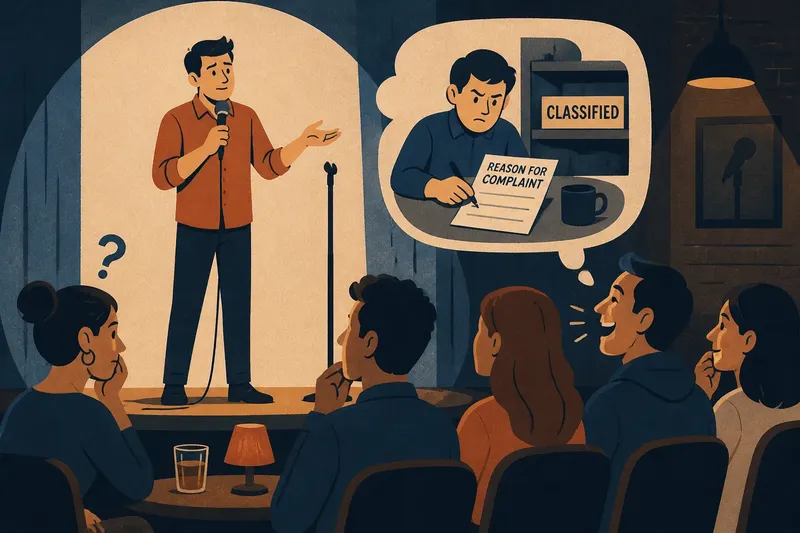
Say you have an invented line about a character who labels the kitchen shelves “classified” because their partner moved the tea. If listeners do not know what “classified” means in this context, the wording or setup may need help. If they understand the label and the petty dispute, but have to connect a minor domestic disagreement with official secrecy, that connection is the comic work. Spelling it out would remove the turn.
Clarify the setup
Give the audience the facts that make the joke legible: who is speaking, what has happened and which detail matters. A setup can be concise without being cryptic. If a listener has to reconstruct the basic scene from missing context, their attention goes into repair rather than anticipation.
Look for vague pronouns, unexplained references and details that arrive too late. “She put it there again” may be difficult to follow if the audience has not been told what “it” is or why its location matters. Naming the object or giving the relevant context can solve that problem without explaining why the situation is ridiculous.
Read the setup aloud and listen for the first point at which a new listener would ask, “Who?” or “What?” Answer that question with the smallest useful piece of information. Resist adding background that does not change how the punchline lands.
Make the wording legible
Clarity can hinge on a single word. If a punchline depends on a phrase with several plausible meanings, the audience may follow a different route from the one you intend. Sometimes that detour is a bonus; sometimes it blocks the joke.
Check whether the key word sounds familiar in the context and whether its reference is clear. A line about “the bank” might suggest a financial institution or a river’s edge. If the ambiguity is intentional, give the audience enough surrounding information to recognise both readings. If it is accidental, replace the word or sharpen the preceding detail.
Keep the sentence’s shape easy to hear. Long qualifications, nested clauses and a late-arriving subject can hide the comic idea, especially when listeners encounter the line only once. Try a more direct construction, then keep the texture and voice that make it yours.
Protect the inference
Once the audience has the necessary facts, let them connect the dots. A joke often gets its lift from the gap between what is said and what can be inferred: a grand claim paired with a petty motive, a confident response to the wrong problem, or a detail that quietly changes the scene’s meaning.
When revising, mark the exact point where the audience can make that connection. Then inspect the words that follow. If they merely translate the implication into plain prose, try cutting them. A line such as “I’m guarding the tea because my partner moved it” may clarify the premise but leave no discovery. The audience already knows the reason; the comic charge is in the disproportion between the tea and the security language.
Do not confuse inference with a scavenger hunt. If listeners must remember a minor detail from much earlier, understand an obscure reference and infer an unstated relationship all at once, the joke may be asking them to do too much. Keep the essential clue close to the turn, and let the inference itself provide the pleasure.
Test one edit
Try a small revision rather than rewriting the whole passage. If the setup is unclear, add or change a concrete cue. If the wording is muddy, simplify that phrase. If the audience gets the premise but the joke feels laboured, remove the sentence that explains the implication.
Imagine a fictional performer whose line describes a character submitting a formal complaint because someone borrowed a mug. The audience sees a form labelled “Reason for complaint”, but the character then says, “I’m treating this like a major legal dispute, even though it’s only a mug.” That final explanation repeats the contrast. The performer could instead cut it, leaving the form and the disproportionate procedure to make the point; the observable result to look for is whether the audience can follow the scene without the extra sentence.
When reviewing a performance, note where the audience’s attention seems to falter, but do not treat every quiet beat as evidence that a line needs explanation. A listener may be processing the turn, or the joke may simply not be working. Ask what information was available at the moment of the line and make one targeted change before deciding anything more.
Which kind of clarity helps?
How can I tell whether a joke is confusing?
Check whether a listener can identify the speaker, situation and detail that makes the turn possible. If one of those is missing, clarify that piece; if the premise is understood but the audience must connect the comic contrast, preserve that work.
Should I explain a joke that gets no laugh?
Not automatically. First decide whether the setup was hard to follow, the wording unclear or the comic connection unconvincing, because an explanation may patch only the first two and can weaken the third.
Can ambiguity make a joke stronger?
Yes, when the audience can follow more than one meaningful reading and the alternatives add to the joke. Ambiguity that obscures who did what or what a line refers to tends to create confusion rather than comic discovery.
What should I cut from a punchline?
Look for words that restate a contrast the audience can already see, particularly a final sentence that translates an implication into an explanation. Keep any detail that makes the intended turn understandable or gives the audience a fresh comic idea.
Keep the useful gap
Before settling on a revision, read the joke aloud in its actual context. The surrounding line may already supply the clue, making an extra explanation unnecessary; a sentence that looks essential on the page can be redundant in performance.
The search for a perfectly clear joke can turn into a search for a joke with nothing left to discover. Aim instead for a clear route into the scene and a lively gap at the turn. If you are editing for clarity, the useful question is not “Have I explained everything?” but “Does the audience have what it needs to make the connection?”