Sketch or Monologue: Two Different Shapes for a Comic Idea
Sketch or monologue? See how the same comic premise changes shape through ensemble action or direct address, and choose a form that gives it room.
A sketch or monologue can make the same comic premise feel like two different stories. Imagine a community theatre has misplaced the key to its costume cupboard just before a rehearsal. The predicament is simple; its comic shape depends on who gets to act, who gets to speak, and how the audience receives each new complication.
In a sketch, the key can pass through a cast of characters, gathering misunderstandings as it goes. In a monologue, one speaker can turn the lost key into a personal account, selecting details and opinions that reveal the speaker as much as the situation. Neither form is inherently funnier. Each offers a different route from premise to payoff.
One premise, two routes
For this invented situation, let the starting point be precise: rehearsal is waiting, the costume cupboard is locked, and nobody knows where its key has gone. Keep the stakes modest. The group needs the costumes, but there is no danger or emergency; the pressure comes from people trying to appear helpful while making matters less orderly.
That premise contains a comic engine: each attempt to solve the problem can create a fresh problem. A sketch can distribute those attempts among several people. A monologue can have one person recount them, shaping the sequence through memory, judgement and selective emphasis.
Before choosing, ask what supplies the richest material. If the fun lies in competing behaviour, a sketch gives those behaviours room to collide. If the fun lies in one person’s peculiar interpretation, a monologue lets that voice take the lead.
The sketch’s ensemble turns
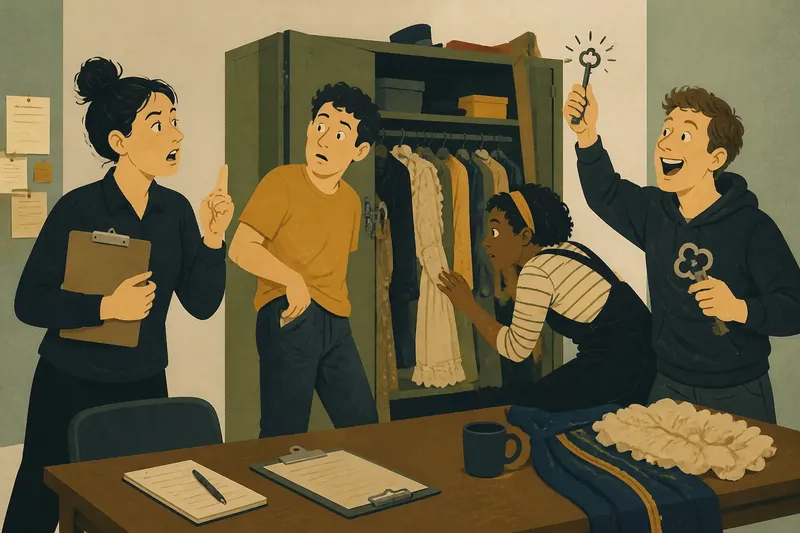
In the sketch version, the rehearsal room becomes a small world with several competing ideas of competence. The stage manager wants an orderly search; an actor insists the key must be in a pocket; another performer begins checking the costume rack as if the garments might offer a clue. Each entrance or change in tactic alters the group’s situation.
The form works through visible relationships. One character can interrupt another, claim authority, misunderstand an instruction or quietly act on a foolish assumption. The audience watches the difference between what people say they are doing and what their behaviour reveals. Dialogue is only part of the action: a character guarding an empty clipboard can be funny before anyone explains why.
To give the sequence shape, make each attempt distinct and let it change the room. The stage manager might organise a search, only for the cast to treat the seating plan as a map of the cupboard. A performer may announce that the key has been located, then discover they are holding a prop key from the play. These are invented turns, not required beats; the point is that one turn should leave the group in a new position.
The sketch can then build towards a payoff that belongs to the ensemble. Perhaps the key is found in plain sight, attached to the person who has been directing everyone else. The reveal lands because the group’s confident activity has overlooked the simplest possibility, and because the audience has watched that confidence accumulate.
For this form, track who changes the situation at each turn; a string of interchangeable reactions will feel like repetition.
The monologue’s direct address
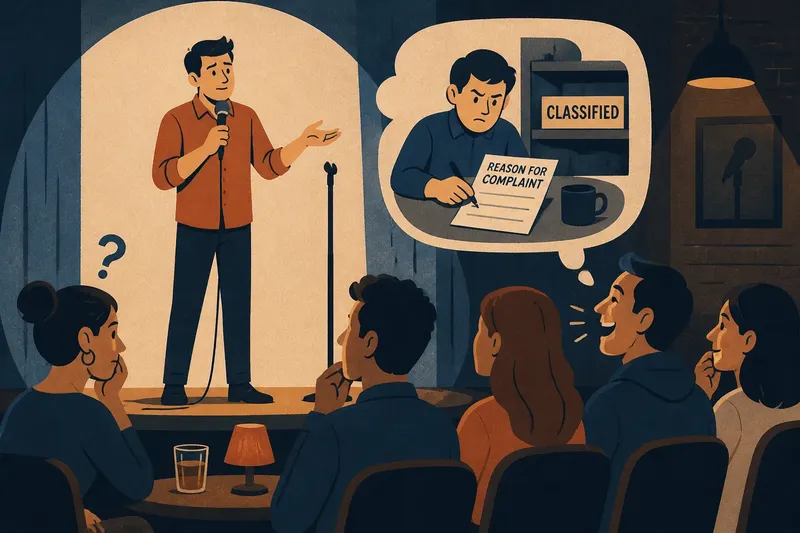
In the monologue version, one performer speaks to the audience about the same locked cupboard. The speaker might be the stage manager, recounting the search as an account of professional responsibility. The room’s other people never need to appear; the speaker’s descriptions and impressions create them in the listener’s mind.
Direct address gives the speaker control over selection. They can skip the boring stretches, linger on a small indignity and describe each colleague in a revealing phrase. The audience hears not only what happened but how this person arranges the story. A claim such as “I took charge” may sit beside a detail that suggests the speaker has no idea where the key is.
The monologue’s turns come from changing perspective rather than moving a cast around. The speaker may begin with an official account, drift into a complaint about the actor who searched the wrong pocket, then admit to having put the key somewhere “safe”. Each admission revises the audience’s picture of the narrator. A final discovery—that the speaker has been carrying the key—can work if earlier details make the confession feel earned rather than arbitrary.
Performance choices matter here. A shift in posture can distinguish the speaker’s imitation of an overconfident actor; a glance towards an imagined cupboard can make the room feel present without furniture. But a monologue does not need constant character impressions or elaborate movement. A clear, specific voice can carry a changing account with little more than a chair and attentive delivery.
For this form, make every anecdote or aside alter the audience’s understanding of the speaker or the problem.
What changes on stage?
The same premise asks for different resources in each format. A sketch needs performers whose actions and points of view are distinguishable, even in a compact scene. A monologue needs a speaker with enough verbal and physical variation to keep the account moving without relying on unseen action alone.
Staging can underline that difference. A sketch might use a table, a clipboard and a rack of costumes, with each object becoming part of the group’s search. A monologue could use only a chair, leaving the speaker’s language to establish the rehearsal room. Props should earn their place: if an object does not prompt action, clarify a detail or support a payoff, it may be visual clutter.
Audience attention also travels differently. In a sketch, the audience tracks relationships and watches for the next person to disrupt the plan. In a monologue, attention gathers around the speaker’s account and the gap between their self-image and their details. A laugh may come from a physical choice in one form, from phrasing or disclosure in the other.
Rehearsal offers a practical way to notice which shape is carrying the idea. Read the premise aloud as a single speaker’s story, then try it with two or more performers whose goals differ. Keep the version in which each beat creates a new comic turn; do not preserve a format merely because it was the first one imagined.
Which format fits best?
When is a sketch the stronger choice?
Choose a sketch when the comedy depends on people affecting one another in real time. Conflicting tactics, status shifts, physical business and a group’s shared mistake all benefit from being visible between performers.
When does a monologue suit the premise?
Choose a monologue when one person’s perspective is the main source of comedy. A distinctive narrator can transform a minor inconvenience through selective memory, self-justification or an unexpectedly elaborate description.
Can one idea work in both formats?
Yes, if each version finds its own comic engine rather than copying the same sequence of events. Give the sketch playable interactions and give the monologue a revealing narrator; the outcomes may share a premise without sharing the same jokes.
What if the premise feels thin?
Ask what can change after the starting situation is established. If the answer is a series of different people making the problem worse, explore a sketch; if it is a speaker revealing more through the telling, explore a monologue.
Lessons from the cupboard
Return to the imagined rehearsal room. The sketch’s route is outward: the missing key changes how a group behaves, and the final discovery completes that pattern of shared misjudgement. The monologue’s route is inward: the search becomes a story about the person telling it, whose account gradually exposes a flaw in their own authority.
That distinction is more useful than asking which format is generally better. A premise about a lost object can support either form, but the writer must choose where the comic pressure lives: among people acting together, or inside one person’s version of events.
When deciding between sketch or monologue, try describing the comic turn without naming the format. If it sounds like “they keep responding to one another until the group creates its own trap”, the ensemble is doing the work. If it sounds like “the narrator keeps revising the story until their own part becomes unavoidable”, direct address has the stronger path.
A small premise does not need a bigger problem to become playable. It needs a clear source of change, and a format that lets the audience see or hear that change unfold.